
Ask most people about AI in the automotive industry, and you get two words back: self-driving cars. Fair enough - that is the part with the marketing budget. But we have spent years on the unglamorous end of this business, buying vehicles that have reached the end of the road, and from where we sit, the more interesting story is unfolding in salvage yards, dismantling floors, and the back offices of companies like ours.
So here is what is actually changing. With numbers, not press releases.
The short version
Artificial intelligence now touches every stage of a vehicle's life. Automakers use it to design components and catch defects on the line. Dealers use it to price inventory. Insurers use it to estimate damage from a smartphone photo. And when a car is finally finished, recyclers and junk car buyers use it to value the vehicle, grade the parts, and answer the phone at two in the morning.
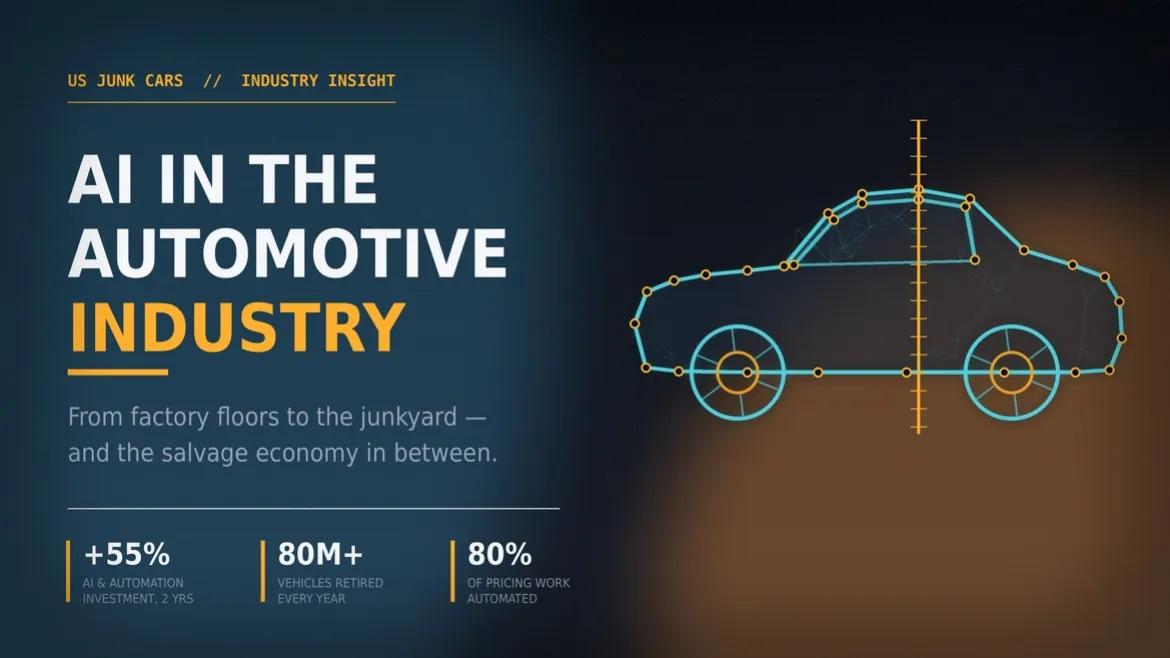
Investments in AI and automation for vehicle recycling have climbed roughly 55% over the past two years. That is not a pilot program anymore. That is an industry rebuilding how it works.
Why the end of a car's life matters more than you would think
Here is a figure that surprises people: the global vehicle fleet has passed 1.4 billion units, and somewhere between 80 and 100 million vehicles reach end-of-life every single year. Each one is a rolling warehouse - steel, aluminum, copper, catalytic metals, and increasingly lithium-ion battery materials.
You cannot process that volume with clipboards and gut instinct. Which is exactly why the recycling side of the automotive industry has quietly become one of its fastest AI adopters.
Vehicle valuation in minutes, not hours
Traditional junk car appraisal meant somebody eyeballing the vehicle, checking a scrap steel price sheet, and making a judgment call. AI valuation engines now pull auction histories, regional scrap pricing, live parts demand, and seasonality to price a vehicle almost instantly. Operations running these systems report automating up to 80% of their pricing workflow.
This is the change our sellers feel most directly. When USJunkCars.com gives you a number, it is not a low opening bid built to be negotiated down. It reflects what your vehicle is genuinely worth in your region, this week.
Part grading by computer vision
Grading a used fender or transmission always depended on who was doing the grading. Image recognition now photographs a part, spots imperfections a tired eye would miss, and compares it against millions of past listings to assign a consistent grade. That consistency is what lets insurers and body shops trust recycled parts - and trusted recycled parts are what keep salvage values healthy for everyone selling a car.
Smarter dismantling decisions
VIN-based decision engines tell a yard, before a car is even unloaded, which components are worth pulling and which should head straight to the shredder. AI demand-matching platforms that connect recovered parts to buyer networks in real time have improved inventory turnover by as much as 40% compared with traditional lot-based selling.
Robotics on the yard floor
Robotic arms now handle some of the most dangerous dismantling work. Facilities that invested seriously in automation typically recoup the cost within three to five years, and some report recovery of valuable components improving by around 40%.
AI adoption in auto recycling: the numbers
| Metric | Reported figure |
|---|---|
| Growth in AI and automation investment (last 2 years) | ~55% |
| Pricing workflows automated | up to 80% |
| Inventory turnover improvement (AI demand matching) | up to +40% |
| Valuable component recovery improvement | up to +40% |
| Typical ROI period on yard automation | 3-5 years |
| Vehicles reaching end-of-life annually, worldwide | 80-100 million |
What about the rest of the industry?
Recycling is one chapter. Across the wider automotive industry, AI shows up in four main places.
Design and manufacturing. Generative design software proposes lighter, stronger components. On the assembly line, computer vision inspects welds and paint at a speed no human inspector could match, catching defects before they turn into recalls.
Driving itself. Lane keeping, automatic emergency braking, adaptive cruise control - all machine learning under the hood. Full autonomy gets the headlines, but driver assistance is the AI most people actually use every day.
Predictive maintenance. Modern vehicles stream sensor data, and models flag a failing water pump or worn pads before they strand you. Commercial fleets have run this for years. It is trickling down to consumer apps now.
Sales, service, and customer contact. Dealers price trade-ins with AI. Insurers settle claims from photos. And a growing share of first contact across the entire industry now happens with software rather than a person.
That last one deserves its own section, because it is the part we know best.
The part nobody writes about: AI answering the phone
Most articles about the future of AI in the automotive industry stop at the factory gate. But there is a quieter shift in how automotive businesses actually talk to customers, and having run a junk car buying operation for years, we can tell you it reshaped our day-to-day more than any robot arm ever did.
Five years ago, selling a junk car meant calling three yards, describing your car three times, sitting on hold, and haggling with whoever picked up. At USJunkCars.com, AI now carries a large share of that workflow. Incoming calls and web leads are processed automatically, vehicle details are matched against live scrap and parts pricing, and a seller gets a firm quote in minutes instead of playing phone tag for a day. A human still makes the call on edge cases - a rare model, a car carrying aftermarket parts worth more than the shell, a title complication - but the routine eighty percent now moves at software speed.
We are not the only automotive business working this out. Independent repair shops face the same problem from the opposite direction: every missed call is a booked bay lost, and nobody can staff a front desk twenty-four hours a day. Purpose-built tools like AI receptionists for auto repair shops now answer, qualify, and schedule around the clock - the same underlying technology that makes sure a seller with a tired old Camry never reaches a busy signal on our end.
Fraud detection is another unglamorous win. AI tools flag suspicious transactions and title inconsistencies before money changes hands, which matters a great deal when a single engine can be worth a couple of thousand dollars.
The regulation tailwind
There is a policy force pushing all of this forward. The EU End-of-Life Vehicles Directive requires that at least 95% of a vehicle's weight be reused or recovered, and North American regulators are moving in the same direction. Hitting numbers like that manually is close to impossible. AI-driven sorting, material tracking, and automated environmental reporting are becoming the only realistic route to compliance, and to proving it with data rather than promises.
Add the EV wave, and it gets more complicated fast. Lithium-ion battery recovery, rare earth reclamation, specialized polymer dismantling - none of it existed at scale a decade ago, and all of it depends on precise identification and handling that AI makes practical. It is also why the offer on a modern hybrid or EV looks nothing like the flat scrap-weight math that governed this business twenty years ago. Knowing that difference is a large part of what USJunkCars.com does for a living.
Where this is heading
Three things we would put money on, based on what we already see in our own pipeline.
Instant, binding offers become the standard. If software can price a salvage vehicle from a VIN and a few photos in minutes, "bring it in and we will take a look" stops being an acceptable answer.
Grading standards go global. Industry associations and the major marketplaces are already working toward aligned, AI-assisted grading and certification for recycled parts. Once insurers fully trust those grades, recycled-part usage climbs, and so do the values flowing back to vehicle owners.
The junkyard becomes a data business. The operations that win will not be the ones with the biggest crusher. They will be the ones who know, part by part, exactly what each car is worth.
The bottom line
The automotive industry loves to talk about AI in terms of the car of the future. The more honest story is that AI is already working the entire lifecycle: designing the car, building it, helping you drive it, and finally, when the odometer has nothing left to give, making sure it is valued fairly and recycled properly.
That last stretch is where USJunkCars.com lives. We have watched this shift from the inside, and it has made the business measurably better for the people on the selling end - faster answers, fairer numbers, far less runaround. The technology changed. What it is worth to do this well did not.
Got a car that has seen better days? Get an instant offer from USJunkCars.com - our AI-assisted pricing puts a real number on your vehicle in minutes, free towing included, and a real person picks up if you would rather talk it through.